Overview
The world we know today has been shaped by communication – the spread of information, ideas and knowledge between people and peoples. Over the course of our history we have used many different materials to display or carry our messages – rock and stone, wood, clay, bark, wax, silk, cloth, reeds (papyrus) and skins (parchment and vellum) – but, undoubtedly, the material that has played the most significant role of all has been paper.
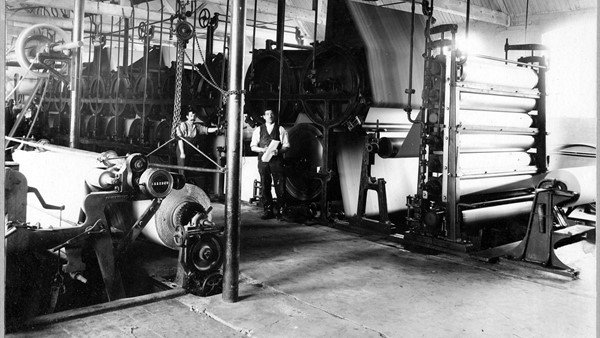
Invented in China around 200 BCE, the technology of papermaking did not reach Western Europe for another 1000 years and it was a further 450 years before it reached England. However, paper’s unique ‘hi-tech’ properties – easy to use, lightweight, strong, durable, highly portable, flexible and easy to manufacture in volume – soon led to it becoming the medium of choice for virtually all recording and communication. Even so, it was not until the invention of a mechanised paper manufacturing process that paper’s true power was unlocked.
Only with the availability of a mass-produced, inexpensive communication medium were we able at last to properly exploit the true potential of the printing press. The marrying of mechanised papermaking with mechanised printing in the latter part of the 19C ushered in the era of ‘mass circulation’ newspapers, education for all and the worldwide exchange of knowledge that fuelled the great expansions of the nineteenth and twentieth centuries.
From plans for buildings, cities, planes, trains and automobiles; books on fact, fiction, science, arts and crafts; newspapers, magazines, pamphlets, flyers and posters; letters, bills, reports and post; paper has played a key role in shaping almost every aspect of the world we know today.